Quickstart
drippy is a Python EDA library following principles from the
NIST/SEMATECH e-Handbook of Statistical Methods.
The entry point is EDAData, a validated container that holds your response
variable y and optional auxiliary arrays. Every plot function accepts an
EDAData object as its first argument.
The four data models
Model |
Constructor |
Use case |
|---|---|---|
Univariate |
|
One response, no predictors |
Time series |
|
Response indexed by a continuous variable |
One-factor |
|
Continuous or categorical single predictor |
Multi-factor / DOE |
|
Named factor arrays for designed experiments |
%matplotlib inline
import numpy as np
import matplotlib.pyplot as plt
from drippy import EDAData
Univariate data
The simplest case: 200 ceramic-strength measurements drawn from a normal
distribution. Only y is required.
rng = np.random.default_rng(42)
y = rng.normal(loc=688.0, scale=65.0, size=200)
data = EDAData(y=y)
print(f"n={len(data.y)}, mean={data.y.mean():.1f}, std={data.y.std():.1f}")
n=200, mean=686.0, std=57.2
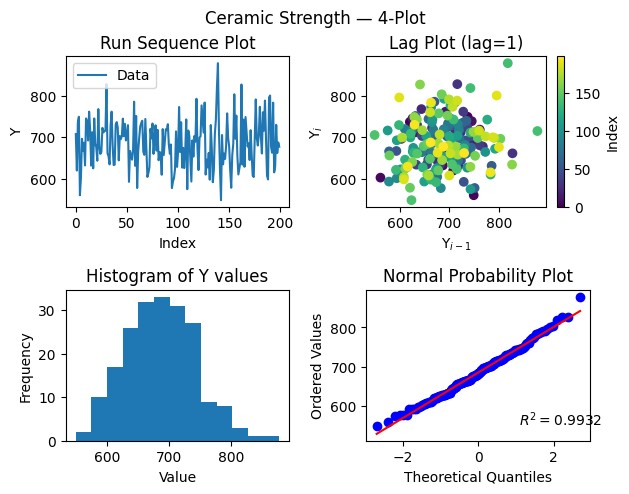
The 4-plot: first stop in any EDA
The NIST handbook recommends starting every univariate EDA with the 4-plot (NIST 1.3.3.5): a 2×2 composite of the run-sequence plot, lag plot, histogram, and normal probability plot. Together these four panels answer the four fundamental questions:
Is the process fixed (constant location)?
Is the process random (no autocorrelation)?
Is the distribution unimodal?
Is the distribution approximately normal?
from drippy import four_plot

fig, axes = four_plot(data)
fig.suptitle("Ceramic Strength — 4-Plot", y=1.02)
plt.show()
Fluent API
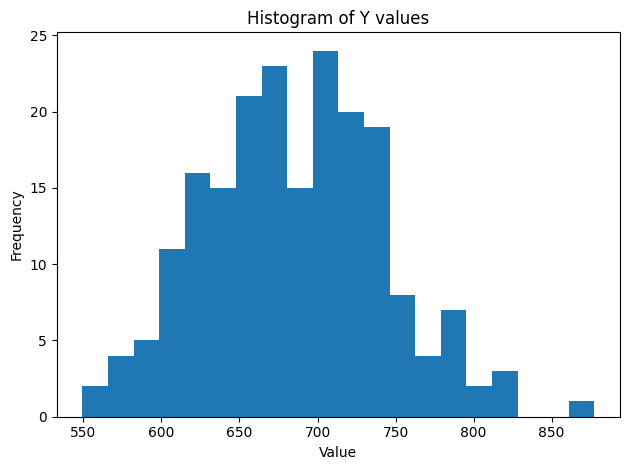
Every plot function is also available as a method on EDAData:
fig, ax = data.histogram(bins=20)
plt.show()
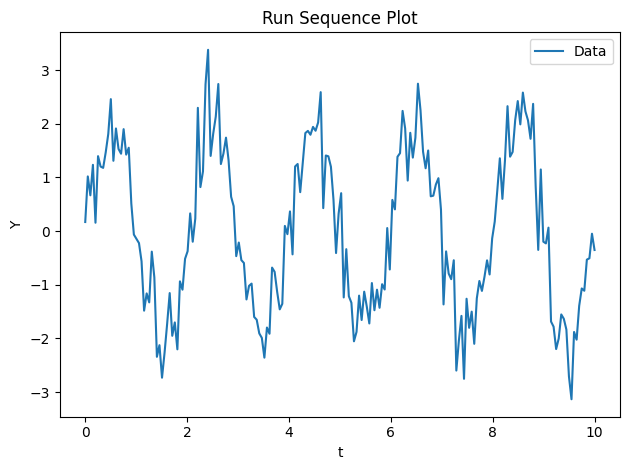
Time-series data
t = np.linspace(0, 10, 200)
noise = rng.normal(scale=0.5, size=200)
y_ts = 2.0 * np.sin(2 * np.pi * 0.5 * t) + noise
data_ts = EDAData(y=y_ts, t=t)

fig, ax = data_ts.run_sequence_plot()
plt.show()
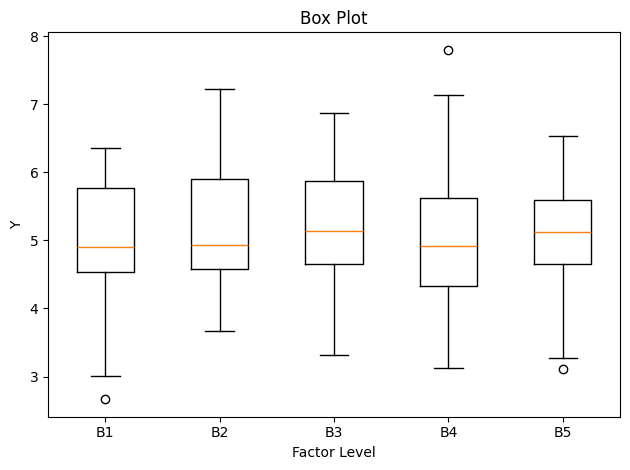
One-factor (categorical) data
batches = ["B1", "B2", "B3", "B4", "B5"]
x_cat = np.repeat(batches, 20)
locs = [5.0, 5.5, 4.8, 5.2, 5.1]
y_cat = np.concatenate([rng.normal(loc=l, scale=1.0, size=20) for l in locs])
data_cat = EDAData(y=y_cat, x=x_cat)

fig, ax = data_cat.box_plot()
plt.show()
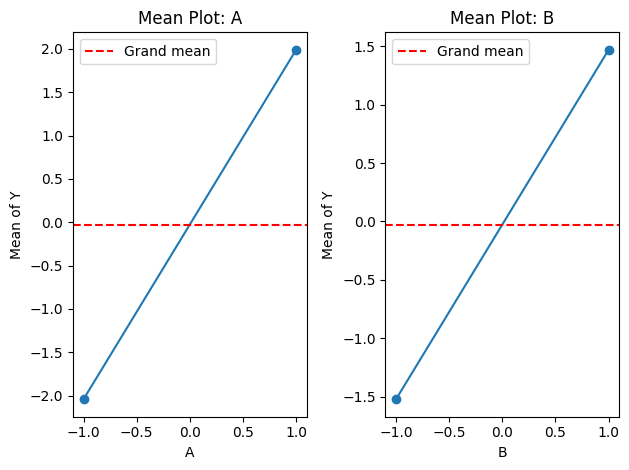
Multi-factor / DOE data
A = np.tile([-1, 1], 8)
B = np.repeat([-1, 1], 8)
y_doe = 2.0 * A + 1.5 * B + rng.normal(scale=0.3, size=16)
data_doe = EDAData(y=y_doe, factors={"A": A, "B": B})

fig, axes = data_doe.doe_mean_plot()
plt.show()